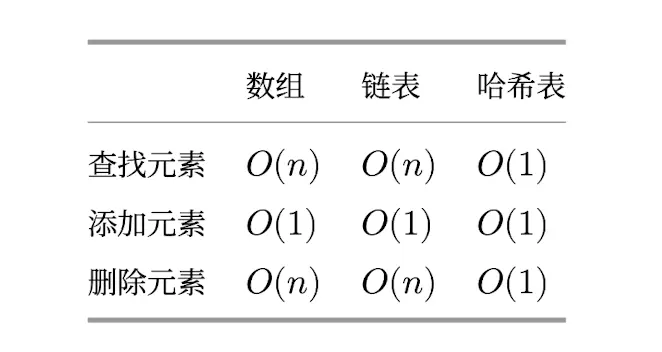
哈希表(hash table),又成散列表,它通过建立key与value之间的映射关系,实现高效($O(1)$ )元素查询。
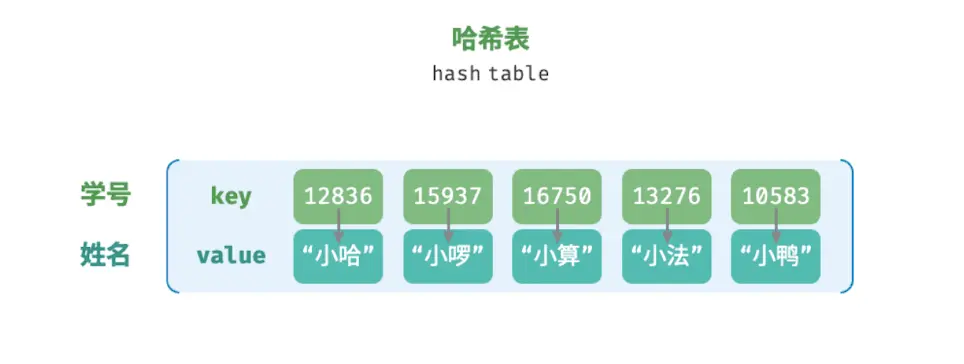
哈希表常用操作
unordered_map<int, string> map;

map[12836] = "小哈";
map[10583] = "小鸭";

string name = map[12836];
map.erase(10583);

for (auto kv: map) {
  cout << kv.first << " -> " << kv.second << endl;
}

for (auto iter = map.begin; iter != map.end(); ++iter) {
  cout << iter->first << " -> " << iter->second << endl;
}
哈希表的实现
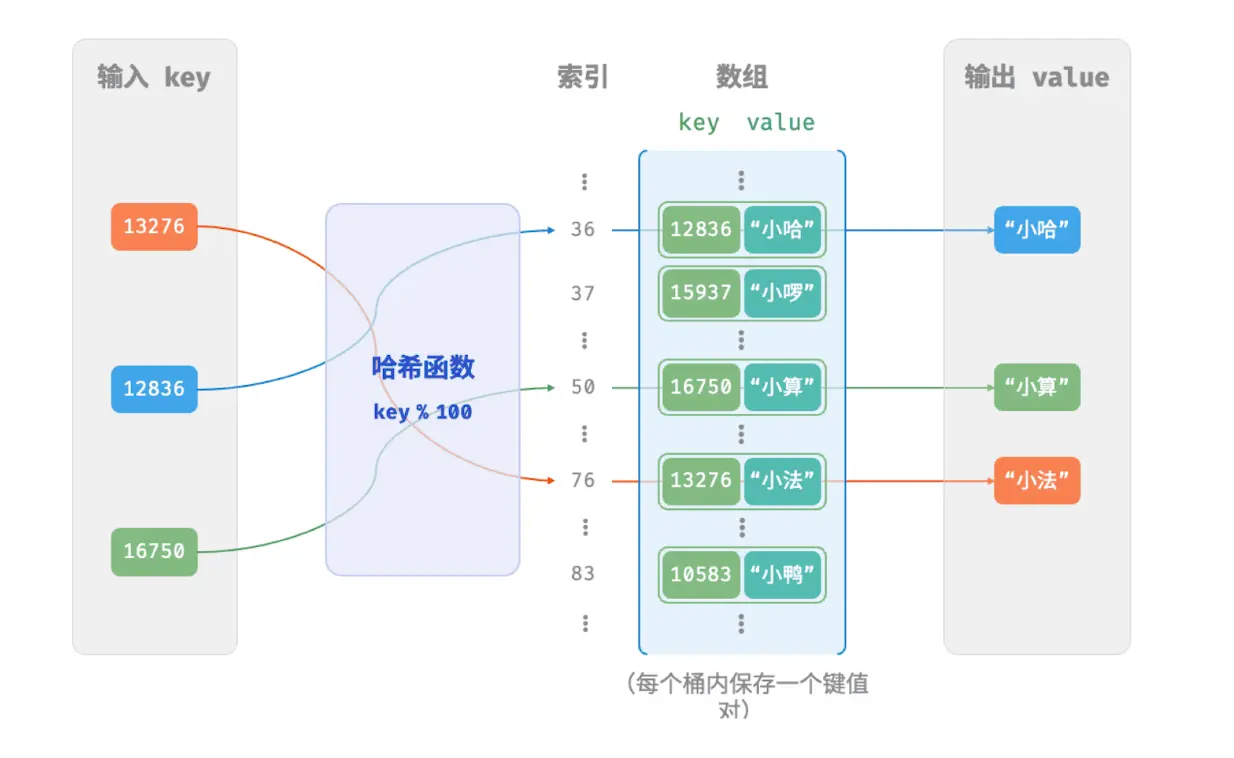
哈希表的工作原理是输入一个key,通过哈希函数查询索引并得到value。
struct Pair {
public:
  int key;
  string val;
  Pair(int key, string val) {
    this->key = key;
    this->val = val;
  }
};

class ArrayHashMap {
private:
  vector<Pair*> buckets;
public:
  ArrayHashMap() {
		buckets = vector<Pair*>(100);
  }

  ~ArrayHashMap() {
    for (const auto& bucket : buckets) {
      delete bucket;
    }

    buckets.clear();
  }

  int hashFunc(int key) {
    int index = key% 100;
    return index;
  }

  string get(int key) {
    int index = hashFunc(key);
    Pair* pair = buckets[index];
    if (pair == nullptr) {
      return "";
    }
    return pair->val;
  }

  void put(int key, string val) {
    Pair* pair = new Pair(key, val);
    int index = hashFunc(key);
    buckets[index] = pair;
  }

  void remove(int key) {
    int index = hashFunc(key);
    delete buckets[index];
    buckets[index] = nullptr;
  }

  // 获取所有健值对
  vector<Pair*> pairSet() {
    vector<Pair*> pairSet;
    for (Pair* pair : buckets) {
      if (pair != nullptr) {
        pairSet.push_back(pair);
      }
    }

    return pairSet;
  }

  void print() P
    for (Pair* kv : pairSet()) {
      cout << kv->key << "->" << kv->val << endl;
    }
}
哈希冲突
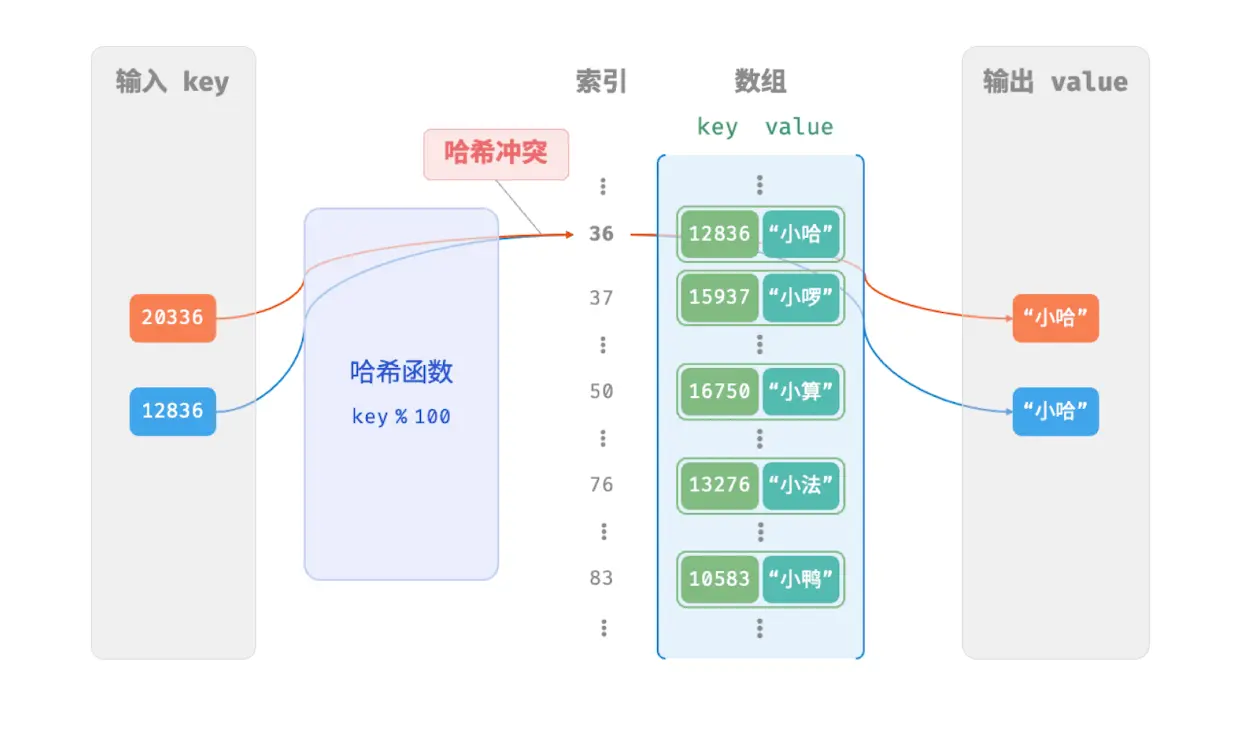
哈希函数的作用是将key所属的较大的输入空间映射到较小的索引所在空间。当输入空间大于输出空间时,会存在多个输入对应相同输出的情况。
扩容(rehash)
解决哈希冲突的最简单方式是扩容。
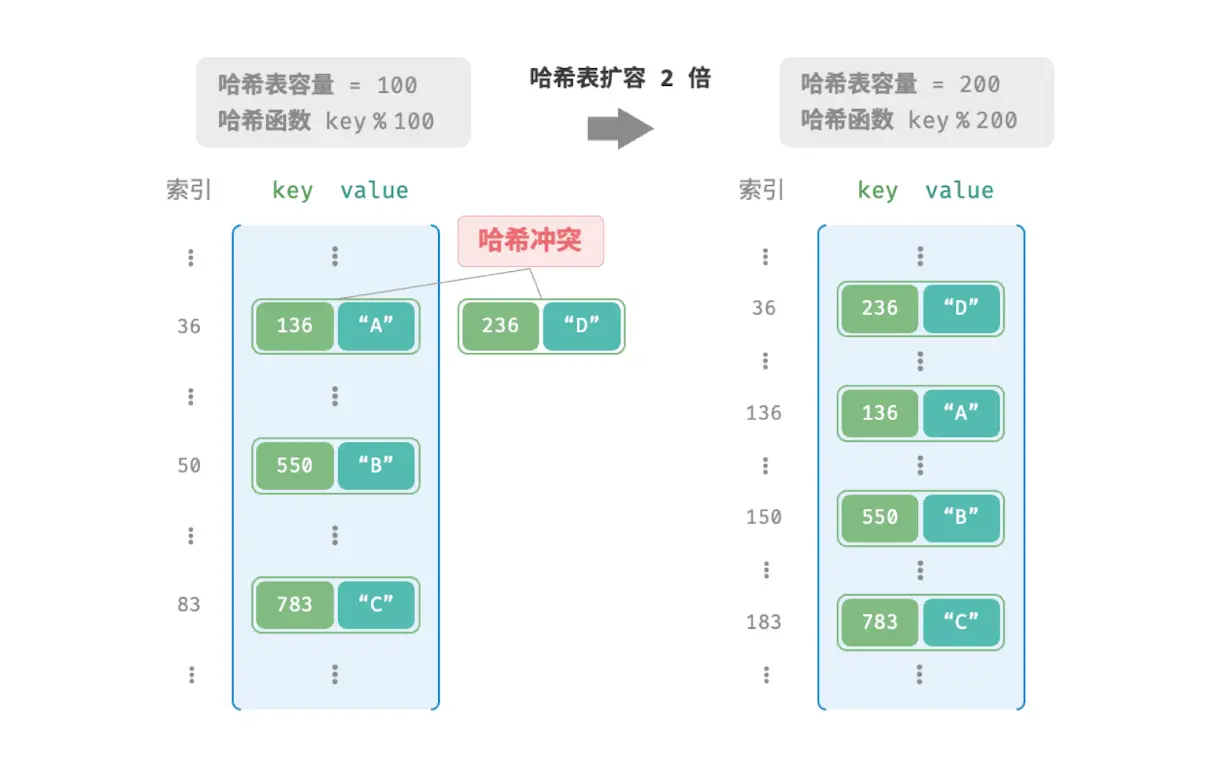
但由于哈希表容量capacity变化时需要重新计算健值对的存储位置,因此需要将所有健值迁移到新哈希表,非常耗时。为了避免频繁扩容,引入了负载因子(load factor) 的概念。它的定义是哈希表的元素除以桶数量,以衡量哈希表的严重程度。
链式地址(separate chaining)
将单个元素转换为链表,将健值对作为链表节点,所有冲突的健值存储在同一个链表中。
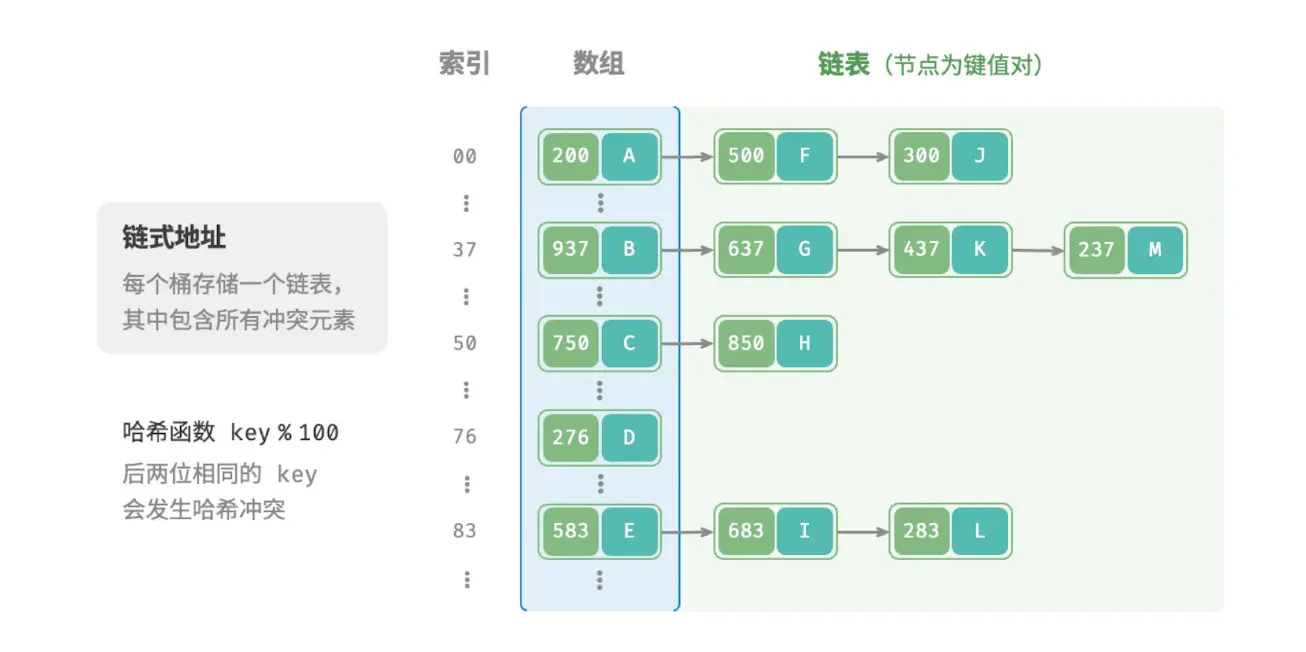
基于链式地址实现的哈希表的操作会发生变化。
- 查询:得到桶索引后会遍历链表并对比key。
- 添加:通过哈希函数访问链表头节点,随后添加到链表中。(一般使用头插,因为最新插入的数据可能被最近访问)
- 删除:得到桶索引后便利链表删除指定节点。
链式地址也存在一些局限性:
- 占用空间增大(链表包含节点指针)
- 查询效率降低(需要遍历链表)
class HashMapChaining {
private:
  int size;
  int capacity;
  double loadThres; // 触发扩容的负载因子阈值
  int extendRatio;   // 扩容倍数
  vector<vector<Pair*>> buckets;
public:
  HashMapChaining(): size(0), capacity(4), loadThres(2.0/ 3.0), extendRatio(2) {
    buckets.resize(capacity);
  }

  ~HashMapChaining() {
    for (auto& bucket : buckets) {
      for (Pair* pair : bucket) {
        delete pair;
      }
    }
  }

  int hashFunc(int key) {
    return key % capacity;
  }

  double loadFactor() {
    return (double)size / (double)capacity;
  }

  string get(int key) {
    int index = hashFunc(key);
    for (Pair* pair : buckets[index]) {
      if (pair->key == key) {
        return pair->val;
      }
    }

    return "";
  }

  void put(int key, string val) {
    if (loadFactor() > loadThres) {
      extend();
    }

    int index = hashFunc(key);
    for (Pair* pair : buckets[index]) {
      if (pair->key == key) {
        pair->val = val;
        return;
      }
    }

    buckets[index].push_back(new Pair(key, val));
    ++size;
  }

  void remove(int key) {
    int index = hashFunc(key);
    auto& bucket = buckets[index];
    for (int i = 0; i < bucket.size(); ++i) {
      if (bucket[i]->key == key) {
        Pair* tmp = bucket[i];
        bucket.erease(bucket.begin() + i);
        delete tmp;
        --size;
        return;
      }
    }
  }

  void extend() {
    vector<vector<Pair*>> bucketsTmp = buckets;
    capacity *= extendRatio;

    buckets.clear();
    buckets.resize(capactiy);
    size = 0;

    for (auto& bucket : bucketsTmp) {
      for (Pair* pair : bucket) {
        put(pair->key, pair->val);
        delete pair;
      }
    }
  }

  void print() {
    for (auto& bucket: buckets) {
      cout << "[";
      for (Pair* pair : bucket) {
        cout << pair->key << " -> " << pair->val << ",";
      }

      cout << "]\n";
    }
  }
}
当链表很长时,可以将链表转换为AVL树或红黑树,从而将查询操作时间复杂度优化为 $O(\log n)$。
开放寻址(open addressing)
开放寻址法无需引入额外的数据结构,而是通过“多次探测”来处理哈希冲突。
探测主要包括线性探测、平方探测、多次哈希等。
线性探测
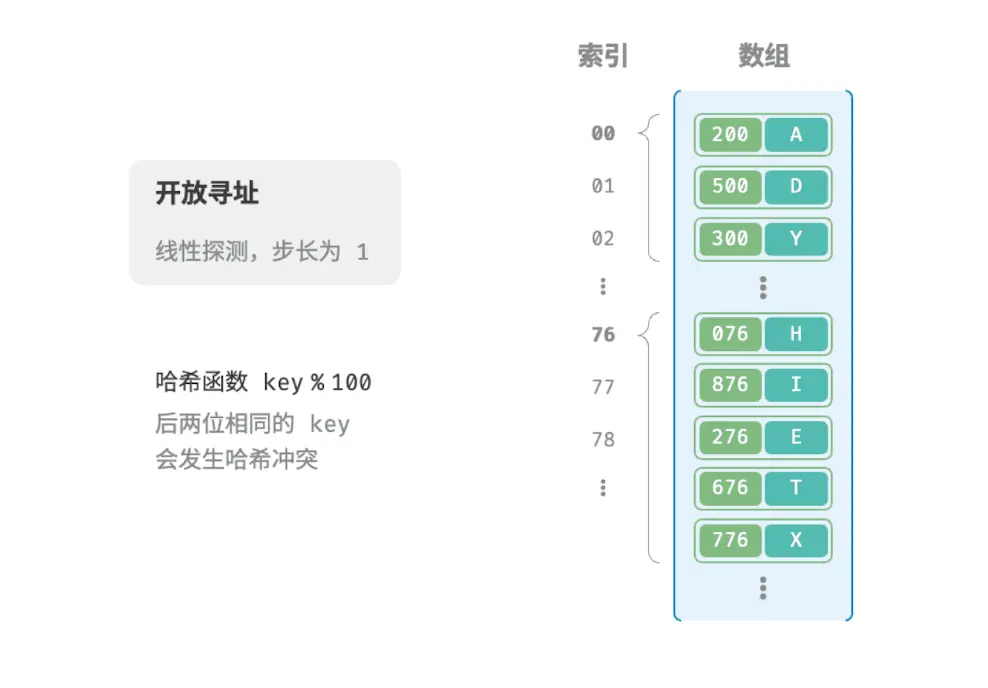
线性探测采用固定步长的线性搜索来进行探测。
-
插入元素:通过哈希函数计算索引后,如果发现桶内已有元素,则向后线性便利,直到找到空桶,将元素插入其中。
-
查找元素:如果发现哈希冲突,则使用相同步长向后线性便利,直到找到对应元素;如果遇到空桶,则说明目标元素不在哈希表中。
-
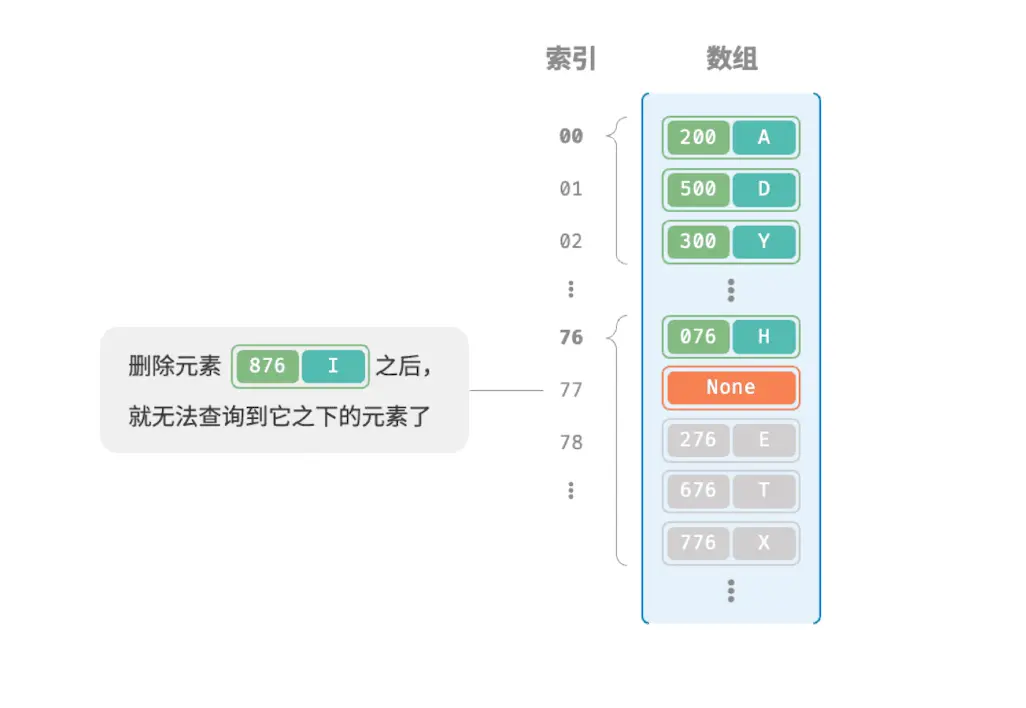
删除操作:为了避免删除导致查找元素操作错误判断空桶,需要配合线性偏移或者懒删除标记来实现删除操作。
[!NOTE]
懒删除会利用TOMBSTONE来标记冲突的桶,在该机制下,None 和 TOMBSTONE都代表空桶,都可以放置健值对,但TOMBSTONE在查找时不会被判定为空桶。
虽然避免了删除过程中的线性偏移,在这种机制下,懒删除会加速哈希表的性能退化。每次删除操作都会产生一个删除标记,这会导致删除标记越来越多。
线性探测的局限性:
- 聚集现象:数组中连续被占用的位置越长,这些连续位置发生哈希冲突的可能性越大。
- 无法直接删除元素:因为查找依赖空桶作为判断是否存在对应元素的依据,因此删除操作需要配合线性偏移使用。
class HashMapOpenAddressing {
private:
  int size;
  int capacity = 4;
  const double loadThres = 2.0 / 3.0;
  const int extendRatio = 2;
  vector<Pair*> buckets;
  Pair* TOMBSTONE = new Pair(-1, "-1");

public:
  HashMapOpenAddressing() : size(0), buckets(capacity, nullptr) {}
  ~HashMapOpenAddressing() {
    for (Pair* pair : buckets) {
      if (pair != nullptr && pair != TOMBSTONE) {
        delete pair;
      }
    }

    delete TOMBSTONE;
  }

  int hashFunc(int key) {
    return key % capacity;
  }

  double loadFactor() {
    return (double) size / capacity;
  }

  int findBucket(int key) {
    int index = hashFunc(key);
    int firstTmobstone = -1;

    while (buckets[index] != nullptr) {
      if (buckets[index]->key == key) {
        // 如果之前遇到了删除标记,则线性偏移
        if (firstTombstone != -1) {
          buckets[firstTombstone] = buckets[index];
          buckets[index] = TOMBSTONE;
          return firstTombstone;
        }

        return index;
      }

      if (firstTombstone == -1 && buckets[index] == TOMBSTONE) {
        firstTombstone = index;
      }

      index = (index + 1) % capacity;
    }

    // key不存在的话,返回第一个可添加点索引。
    return firstTombstone == -1 ? index : firstTombstone;
  }

  string get(int key) {
    int index = findBucket(key);
    if (buckets[index] != nullptr && buckets[index] != TOMBSTONE) {
      return buckets[index]->val;
    }

    return "";
  }

  void put(int key, string val) {
    if (loadFactor() > loadThres) {
      extend();
    }

    int index = findBucket(key);
    if (buckets[index] != nullptr && buckets[index] != TOMBSTONE) {
      buckets[index]->val = val;
      return;
    }

    buckets[index] = new Pair(key, val);
    ++size;
  }

  void remove(int key) {
    int index = findBucket(key);
    if (buckets[index] != nullptr && buckets[index] != TOMBSTONE) {
      delete buckets[index];
      buckets[index] = TOMBSTONE;
      --size;
    }
  }

  void extend() {
    vector<Pair*> bucketsTmp = buckets;
    capacity *= extendRatio;
    buckets = vector<Pair*>(capacity, nullptr);
    size = 0;
    for (Pair* pair : bucketsTmp) {
			if (pair != nullptr && pair != TOMBSTONE) {
        put(pair->key, pair->val);
        delete pair;
      }
    }
  }

  void print() {
    for (Pair* pair : buckets) {
      if (pair == nullptr) {
        cout << "nullptr" << endl;
      } else if (pair == TOMBSTONE) {
        cout << " TOMBSTONE " << endl;
      } else {
        cout << pair->key << " -> " << pair->val << endl;
      }
    }
  }
}
平方探测
平放探测在线性探测的基础上,将步长优化为探测次数的平方,试图缓解聚集效应。但它依旧无法彻底解决聚集现象,因为某些位置在平方计算中依旧作为结果高频出现;同时,即使哈希表中有空桶,平方探测也可能无法访问到它。
多次哈希
多次哈希引入了多个哈希函数 $f_1, f_2, f_3…$,这样如果第一个哈希发生冲突,则使用第二个哈希,在这种情况下,常见操作会调整为:
- 插入元素:如果 $f_1(x)$ 冲突,则使用 $f_2$进行计算,以此类推,直到找到空位。
- 查找元素:在相同的哈希函数下顺序查找,遇到空位或者key不对应的元素,则尝试其他哈希函数,直到尝试所有哈希函数。
它不会产生聚集现象,但会带来额外的计算量。